What Causes Knee Pain?
Does it hurt to move your knee? Maybe your knee hurts at rest. Do you have a structural injury, or a knee joint not moving properly?
Even if you have been struggling with knee pain for months, or even years, it’s not unusual to get better, quickly with the right care plan.
What Is Knee Pain?
Knee pain is simply a painful symptom in or around the knee joint. However, you could be experiencing it for a multitude of reasons.
We often associate pain symptoms with structural issues, such as meniscus or ligament damage. Fortunately, knee pain is not often caused by a structural problem.
If you were not involved in a trauma, such as a major fall or a car accident, there’s no need to worry about damage to your knee. The odds of structural bone, ligament or tendon damage in the absence of trauma is extremely poor. On the contrary, if you suffered major trauma your chances of structural damage increase, but it is not absolute. Not every case of trauma-derived knee pain is a structural problem.
The most common source of knee pain is poor joint mechanics. An interference of proper joint movement eventually leads to sensitivity of nerves and soft tissue structures around the joint, thus causing pain.
When Is It Serious?
“But my physician took X-rays and told me my knees are bone-on-bone.”
Yes, arthritis is commonly found in the knee joints. Arthritis occurs in all joints of the body, especially as we age. If you’re over the age of 50, you’ve got arthritis — it’s a natural aging process. Arthritis is like wrinkles and grey hairs but on the inside. Unless you have arthritis beyond what’s expected for your age, it’s not the problem causing your pain.
RARELY is arthritis a cause of pain. It is more so a contributing factor. Arthritis can alter joint mechanics, increasing the sensitivity of surrounding tissues.
“But I was on the YouTubes and I think I have patellar tendinitis.”
Knee pain near the kneecap can be caused by a tendon issue called patellofemoral pain syndrome, or patellar tendinitis. The symptoms are usually present in athletes or individuals with a sudden increase in physical activity over a short period of time. However, if your knee pain is not activity-dependent — knee hurts when approaching the 2nd mile of the running — tendinopathy is less likely.
Unideal joint movement still more commonly causes anterior knee pain.
Your knee pain is more serious when it’s constant, excruciating, and severely limiting your ability to perform normal activities of daily living. If this has happened as the result of an injury or trauma, seek medical attention ASAP. If it’s been progressively worsening over months to years, hopefully, you’ve sought treatment at some point. If not, it’s not too late.
The Meniscus Myth
A meniscus tear on an MRI sounds like a pretty convincing explanation for knee pain.
And sometimes it is.
But here’s the part that gets missed: meniscus tears also show up on MRIs in plenty of people whose knees don’t hurt at all. In other words, finding a tear doesn’t automatically prove the tear is the reason your knee is painful.
You can have knee pain, get an MRI that shows a degenerative meniscus tear, go through the right rehab, get back to walking, squatting, running, or training comfortably—and that tear may still be sitting there on the scan looking exactly the same.
That’s why we don’t treat the MRI. We treat the person attached to it.
Before assuming the answer is surgery, we want to know how your knee actually behaves: what movements reproduce the pain, what changes it, how well the joint moves, how you load the leg, and whether strength or movement limitations are keeping the area irritated.
For many degenerative meniscus tears, a well-designed rehab program can perform similarly to surgery over the long term.
So the MRI matters. It just isn’t the whole story.
Get the knee mechanically assessed before deciding the picture is the problem.
Can You Have Knee Pain Without Injury?
Not all knee pain is a knee problem.
Wait, WHAT!? I’ll explain.
Pain in the knee, or anywhere in the legs, is commonly a symptom of a low back problem.
“But I don’t have any back pain. How could knee pain come from my back?”
It’s likely you’ve heard of sciatica.
Sciatica is a common symptom originating from the low back. Classic sciatica presents as pain, numbness, or tingling down the back of the leg and can even travel to the calf or down to the foot.
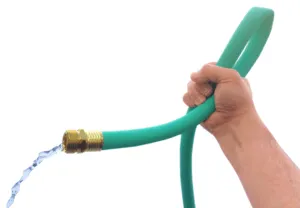
Sciatica is most likely caused by irritation of joints in the low back. The irritated joints can cause interference of the nerves exiting the spine. The nerves exiting the lumbar spine on the left and right of the body converge to form the left and right sciatic nerves, which traverse down the legs.
Any irritation of low back nerves — due to poor joint mechanics — can produce symptoms anywhere along the path of nerves down the legs. And the symptoms, e.g., pain, numbness, tingling, burning, pins & needles, don’t necessarily travel like drawing a line from the back down the leg. Often, sciatica symptoms skip spots. It’s possible to have sciatica symptoms in only the hip and knee, absent of back pain.
Signs Your Knee Pain May Be a Back Problem
- Knee pain accompanied by back pain or stiffness
- Worsens when sitting for long periods of time.
- Improves while or after walking
- No mechanism of injury such as a fall, repetitive strain, or overuse.
The low back is a more common cause of knee pain than you think.
Try This Yourself
Pick one or two movements that reliably bring your knee pain on. Sitting to standing and squatting are the usual ones. Note how they feel. Then do the knee extension exercise in the video below: ten reps, two sets. Retest.
If anything changed, better or worse, the problem is mechanical. Mechanical problems are the ones we can treat.
What You Can Do About It
Keep moving, but find the Goldilocks zone. Too little and the joint stiffens and loses the blood flow that keeps it healthy. Too much bending and you flare it up.
The bigger fix is working around the knee rather than into it.
Hip hinge instead of bending down. Most people trying to protect their back end up loading their knees instead, which is the last thing a painful knee needs.
Kneel rather than squatting to the floor.
Widen your stance if you have to squat. A sumo position takes load off the knee.
How much is enough differs with every knee. That’s most of what we work out in the first couple of visits.
When to Seek Treatment for Knee Problems
Knee pain can be difficult to treat on your own because you must first identify the source(s).
A clinician trained in Mechanical Diagnosis and Therapy (MDT) can clarify whether the symptoms are sourced from the low back, the sciatic nerve, the patellar tendon, or the knee joint itself.
Furthermore, there may be more than one source. Have you heard the saying, “you can have ticks and fleas?” We’ve seen both the low back and knee involved on several occasions.
Knowing the cause(s) of symptoms ensures the proper application of the best treatments and strategies to correct the problem as quickly as possible.
Hands-on active treatments with specific exercises have been proven to be the most effective. In rare cases is surgery absolutely needed. Can you imagine how many knee surgeries have been performed where conservative treatments of the knee failed, but the spine was never assessed as a possible source?!
Pain is frustrating. At REACH, we take the guesswork out of healing. We use a holistic chiropractic approach, assessing the body as a whole rather than treating just the symptoms. So you can do more than relieve pain. We teach you how to become unstoppable.
Surgery Isn’t the Finish Line
Most people expect that once the structure is repaired, everything else falls into place. Sometimes it does. Often it doesn’t.
Surgery fixes structure. It doesn’t automatically fix how the joint moves.
Post-surgical rehab matters, and skipping it causes its own problems. Sometimes the structure doesn’t heal properly without it.
But even done properly, getting your basic range of motion back and managing a normal day isn’t the finish line. If you want to hike, climb, play a sport, or do anything past sitting, standing and stairs, you have to rehab for that specifically. Nobody gets back to something they never trained for.
That’s usually where it lingers. Walking and stairs feel fine, so the knee seems fine, until you try the thing you actually wanted your knee back for.
Plenty of people arrive here months or years after surgery saying a version of the same thing: it helped, but something still isn’t right.
At that point the structure usually isn’t the problem. A mechanical imbalance is. Those can exist with or without structural damage, which is why repairing the structure doesn’t always resolve them. If the imbalance is still there, the symptoms often are too.
So we assess the knee the same way we would if you’d never had surgery. Is the joint stuck moving in one direction? Is something tight or taking more load than it should, and keeping the area irritated? That’s what tells us why it still hurts when the imaging says it shouldn’t.
Cody, In His Own Words
Cody is a personal trainer who had knee surgery and was still dealing with the limitations afterwards.
Ready to get started at REACH?
5.0★ rated by 450+ patients across Plymouth and metro Detroit. Booking online is the fastest way in — or call/text (734) 335-0212.
Book Your First Visit →