Does your back feel completely fine for months, until one ordinary workout, afternoon of yard work, long car ride, or simple bend leaves you wondering how you “threw it out” again?
You have a flare-up. You rest, get treatment, modify what you’re doing, and eventually feel like yourself again. Then six months later, maybe a year later, you’re right back in the same spot.
After enough rounds of this, it’s easy to assume you just have a “bad back.” You start second-guessing lifting, workouts, yard work, long drives, or anything else that might trigger the next episode.
But one part of that pattern matters:
Your back keeps getting better.
That matters.
If you can feel good for months between episodes, the bigger question isn’t simply, “Why won’t my back heal?”
It’s:
“What keeps irritating it again?”
That gives us a pattern we can actually investigate.
The goal isn’t to create a “perfect back” that never gets stiff or sore. It’s to make your back more predictable, capable, and manageable. You understand what tends to stir it up, know what helps, recognize warning signs earlier, and build enough capacity for the things you want to do.
Here are three things we look at at REACH when someone’s low back pain keeps coming back.
Strategy 1: Figure Out Where You Keep Putting Your Hand on the Hot Stove

One of the first things we look for with recurring low back pain is whether something in your normal routine keeps irritating your back without you realizing it.
Think about putting your hand on a hot stove.
You can treat the burn and get it feeling better. But if you keep putting your hand back on the stove, the burn is going to keep coming back.
Back pain can follow a similar pattern.
Someone has a flare-up, gets treatment, feels better, then goes right back to the same routine. Six months later, their back flares again.
Getting them out of pain was not the missing piece. Figuring out what kept stirring it back up was.
A Common Pattern: Lots of Bending and Lots of Sitting
Forward bending is not inherently bad. Your back is supposed to bend.
What matters is how much of that stress you accumulate throughout the day.
Most of what we interact with all day is in front of us. Our phones, computers, shoes, dishes, laundry, kids, tools, and everything else naturally have us bending and reaching forward a lot.
Nobody picks something up off the floor by bending backward with their arms behind them.
Then add hours of sitting. Sitting itself is not bad either, but prolonged unsupported sitting can be another long period of sustained flexion.
Put repetitive bending, prolonged sitting, lots of technology use, not enough general movement, and then a hard workout or four hours of yard work on top of each other, and you can create a pretty good back pain cocktail for someone whose back is already sensitive to that type of stress.
The point is not that you should never bend forward. The point is to pay attention to the dose.
If your back is irritated by a certain stress right now, repeatedly giving it that same stress all day can make it harder to settle down.
Your Next Posture Is Your Best Posture
People often want to know the “correct” posture.
Most of the time, we care less about finding one perfect posture and more about how long you stay in the same position.
Your next posture is your best posture.
Sit for a while, then stand. Lean back. Take a short walk. Change positions and move in different directions throughout the day.
We are built to move with variety, not hold one supposedly perfect posture for eight hours.
How We Use This at REACH
This is why our assessment goes beyond what hurts during the exam. We want to understand what your back is dealing with during the rest of your day.
How much do you sit? What happens after a long drive? What do your workouts look like? How are you bending during yard work or chores? Are there movements you do repeatedly before symptoms show up? Does your back behave differently on workdays compared with weekends?
Those details help us identify behaviors that may be acting like the hot stove.
Early in care, we may temporarily change some of those exposures. That could mean using a lumbar roll at your desk, kneeling for certain tasks instead of repeatedly bending toward the floor, using more of a hip hinge or squat, or simply getting up and moving more often.
Those are not lifetime restrictions.
We are temporarily reducing something your back is not tolerating well while we work on getting you back to normal bending, lifting, sitting, training, and everyday life.
Strategy 2: Learn How Your Back Behaves Instead of Guessing From Where It Hurts
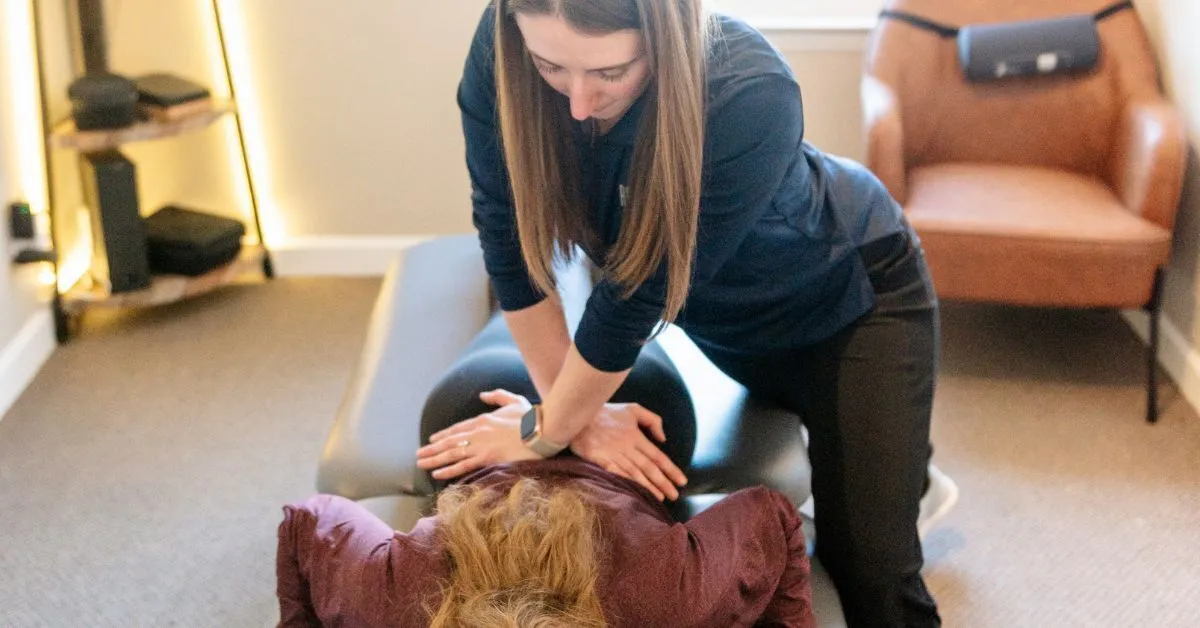
One of the things we pay close attention to with mechanical low back pain is variability.
Patients tell us things like, “Sitting makes it worse, but walking feels good,” or, “I can bend forward, but leaning back feels tight.” It may be worse first thing in the morning and loosen up later. One movement may hurt while another feels completely fine.
That variability gives us clues about the source of the pain and what your back may respond to favorably.
That is why we spend a lot of time asking specific questions about how the pain behaves.
What makes it better or worse? Does sitting, standing, walking, bending, or lying down change it? Does the pain move? What happens when you repeat a certain movement?
Those answers help us form a working theory about the source of the irritation. Sometimes we can also identify a directional preference, which is simply a movement or position your back consistently responds to well.
Then we test the theory.
Establish a Baseline, Then Retest
First, we establish a baseline.
The baseline might be a toe touch, turning, squatting, standing up from a chair, or another movement that is limited or painful right now.
Then we try a movement, position, exercise, or treatment and retest the same baseline.
You may move farther, hurt less, notice the pain change location, or find that the same task simply feels easier.
Improvement gives us useful information. Getting clearly worse gives us information too.
We are not trying to force an exercise to work just because it is supposed to be a “good back exercise.” We want to see how your back actually responds.
Pain Is the Alarm
This is where we like the smoke detector analogy.
Pain is the alarm.
If a smoke detector is going off, you can pull the batteries and make the noise stop. But you still have not figured out what caused the smoke.
We would rather figure out what is creating the smoke.
That is how we think about treatment.
Of course we want the pain to calm down. But we also want to identify the source of the irritation and improve what is contributing to it so the alarm has less reason to keep going off.
Your Home Exercise Should Tell Us Something
Early in care, you may get one simple movement, stretch, or exercise to use between visits.
There should be a reason for it.
We do not want to hand you a sheet of 10 generic exercises and hope one of them works.
Whatever you do at home should help continue what we started in the clinic and give us more information about how your back responds between visits.
If a movement consistently helps, that tells us something. If it stops helping or your symptoms change, the plan should change too.
Over time, you start recognizing those patterns yourself.
That is important because the long-term goal is not for you to need an appointment every time your back feels different.
We want you to understand your back well enough to know what usually helps, what tends to stir it up, and when something is outside the pattern and needs a closer look.
Strategy 3: Build Enough Capacity So Your Back Can Handle Real Life
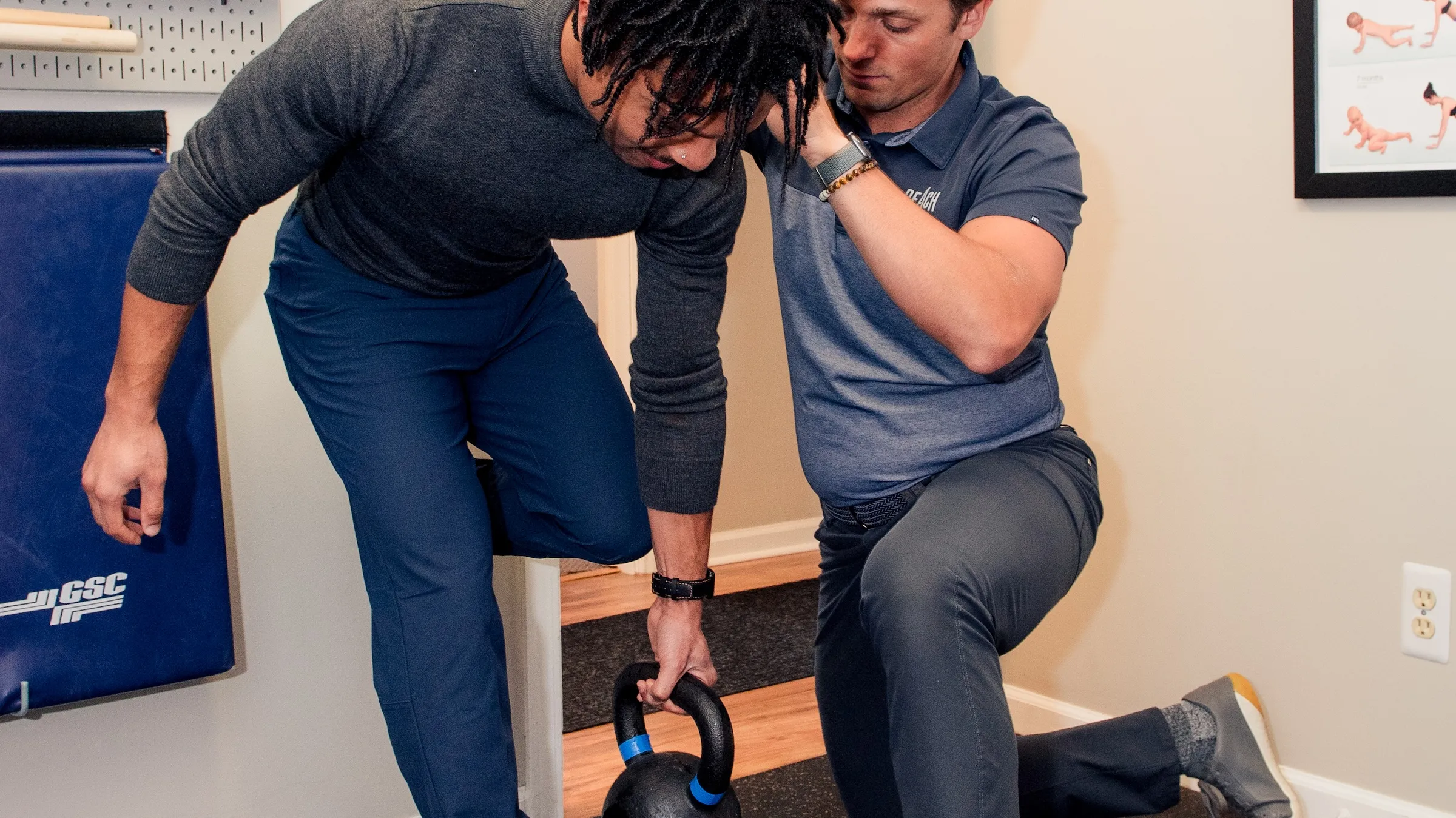
Once pain is settling down and normal movement is coming back, we have another job to do: build enough capacity that your back is less likely to get irritated again.
A lot of people can get out of pain. The harder part is making sure their body is prepared for the next long day in the yard, hard workout, road trip, house project, or whatever else they want to do.
That comes down to capacity.
“Core Strength” Is Only Part of the Picture
Patients often describe this as needing a stronger core, and sometimes that is part of it. We usually want to know something broader:
Can your body handle what you are asking it to do?
Modern life makes this tricky.
A lot of us sit most of the week, then suddenly ask our bodies to do something much more demanding on the weekend.
You sit at a desk Monday through Friday, then spend four hours pulling weeds. You barely lift anything all week, then help someone move a couch. Or you have not trained consistently, then jump into a hard workout because you finally have time.
There may be nothing wrong with the activity itself. Your body just may not be ready for that much of it yet.
Skill and Capacity Are Two Different Things
Functional competence is the skill side of the equation. Do you know how to hinge, squat, brace, lift, or perform the exercise with enough control for what you are trying to do?
Functional capacity is how much of that activity you can tolerate. How heavy is it? How many reps are you doing? How long are you doing it, and how often?
Someone can have excellent deadlift technique and still do far more deadlifting than their body is prepared for. Someone can tolerate 30 minutes of yard work perfectly well and feel awful after four straight hours.
Good technique does not protect you from doing too much.
This Is Where Rehab Needs to Become Training
Early in care, we may be more focused on pain, restoring movement, and getting things to calm down. As you improve, the question becomes:
What does your body actually need to be able to do?
If you want to deadlift again, rehab should eventually look more like preparation for deadlifting.
If you want to golf, hike, garden, lift your kids, travel, run, or work a physical job, we need to prepare you for those demands.
That might mean working on core stability, strength, lifting tolerance, movement skill, conditioning, or gradually rebuilding tolerance to movements that have been bothering you.
Rehab should not just make you good at rehab exercises. It should prepare you for what you actually want to do.
Prevention Should Be Simple Enough That You Will Actually Use It
This is also where we start building a prevention plan.
We are not talking about a 45-minute routine you have to do every morning for the rest of your life. Usually it is much simpler.
Once we know what your back tends to respond to, we can build a few simple strategies you can use when you notice things starting to creep back in.
We sometimes compare this to brushing and flossing.
You do not wait until you have a cavity to start brushing your teeth. You do a small amount consistently because it helps prevent a bigger problem later.
For one patient, repeated back bends became his version of that.
That does not mean repeated back bends are right for everyone. They were a movement we had already established that his back responded well to.
He had a desk job and a history of significant low back flare-ups every six to 12 months. He would get treated, feel better, return to normal life, then eventually end up back in the same cycle.
We already knew we could get him out of pain. What we had not solved yet was why the flare-ups kept coming back.
We kept seeing the same things show up around his flare-ups: prolonged unsupported sitting, lots of repeated bending, and long stretches of yard work or chores.
So we made a few changes.
He started using a lumbar roll at his desk. He became more aware of how much bending he was doing throughout the day and started changing positions more often. And when he noticed that familiar stiffness starting to creep back in, he used the repeated back bends that we already knew his body responded well to.
He has now gone more than two years without a major flare-up.
His back still gets stiff once in a while, and he still occasionally gets lazy about the things he knows help him. The difference is that he knows what is happening and knows how to get himself back on track.
Before, he was seeing a chiropractor about once a month and would ramp up to three visits per week for a few weeks whenever he had a bad episode.
Now he comes in periodically, roughly every eight weeks, and handles far more of the day-to-day management himself.
To us, that is a much better outcome.
We do not want someone dependent on treatment every time their back acts up. We want them to understand their back, have enough capacity for the things they want to do, and know what to do when the warning signs show up.
One patient’s experience. Individual results vary.
So, Is Bending Forward Bad?
No.
Forward bending is a normal human movement, and your back should be able to tolerate it.
We do not want you keeping your spine perfectly straight or avoiding bending for the rest of your life.
What matters is how much bending you are doing, when you are doing it, and what your back currently tolerates well.
If repeated bending is clearly aggravating your back, temporarily changing how often or how much you do can help it settle down.
That might mean kneeling for certain tasks, using more of a squat or hip hinge, changing positions more often, or just cutting down on repeated bending for a while.
Then, as things improve, we build that movement back in.
You should be able to bend, lift, and move your spine normally.
We are not trying to avoid normal movement. We are trying to get your back comfortable with it again.
You Do Not Need a Perfect Back to Break the Flare-Up Cycle
If your low back pain keeps coming back, it does not automatically mean you have a “bad back” or that something never healed.
If you can go weeks or months feeling good between episodes, your back has already shown you that it can recover.
A more useful question is: What keeps setting it off again?
For many people, breaking that cycle means figuring out three things:
- What movements, positions, habits, or workloads may keep irritating your back.
- What your back tends to respond to when symptoms start changing.
- Whether you have enough strength, movement skill, and capacity for the things you regularly ask your body to do.
You may still wake up stiff sometimes, overdo something, or have an ache that does not need treatment.
A better outcome is that your back becomes less mysterious.
You start recognizing when something is creeping in and know what usually helps. You feel more confident bending, lifting, training, doing yard work, traveling, or whatever else matters to you. And if something feels different from your usual pattern, you know when it is worth getting checked out.
That puts you in a much better position than waiting for the next flare-up and hoping it does not happen.
If Your Back Keeps Flaring Up, It May Be Time to Look at the Pattern
If your low back pain keeps getting better and then coming back a few months later, it may be worth figuring out why the pattern keeps repeating.
At REACH, we start by looking at how your pain behaves, what seems to stir it up, what your back responds to well, and what may be contributing to the flare-ups in the first place.
You should leave with a clearer understanding of what is going on and a plan that fits what you actually need.
If your back keeps ending up in the same pattern, book a New Patient Appointment at REACH.
Frequently Asked Questions
Why does my back pain keep coming back?
If your back feels good for weeks or months between episodes, it has already shown it can recover. The more useful question is what keeps irritating it again — usually a movement, position, or workload in your normal routine that keeps stirring it up after each flare-up settles.
Does recurring low back pain mean I have a bad back?
Not necessarily. Recovering fully between episodes is evidence your back heals. Recurrence more often points to a repeated stress that has not been identified, or to capacity that has not been rebuilt for what you are asking your body to do.
Is bending forward bad for your back?
No. Forward bending is a normal human movement and your back should tolerate it. What matters is the dose — how much bending you do, when, and what your back currently tolerates. If repeated bending is clearly aggravating things, temporarily reducing it can help it settle before you build it back in.
What is a directional preference?
A movement or position your back consistently responds to well. Identifying one gives you something specific to use when symptoms start creeping back in, rather than guessing.
Do I need treatment every time my back acts up?
That is not the goal. Once you understand what tends to stir your back up and what helps it settle, most day-to-day management can be handled yourself, with periodic check-ins rather than a course of visits after every episode.
Ready to get started at REACH?
REACH Rehab + Chiropractic · Plymouth, MI · 5.0★ from 450+ patients. Call or text (734) 335-0212.
Book an Appointment →